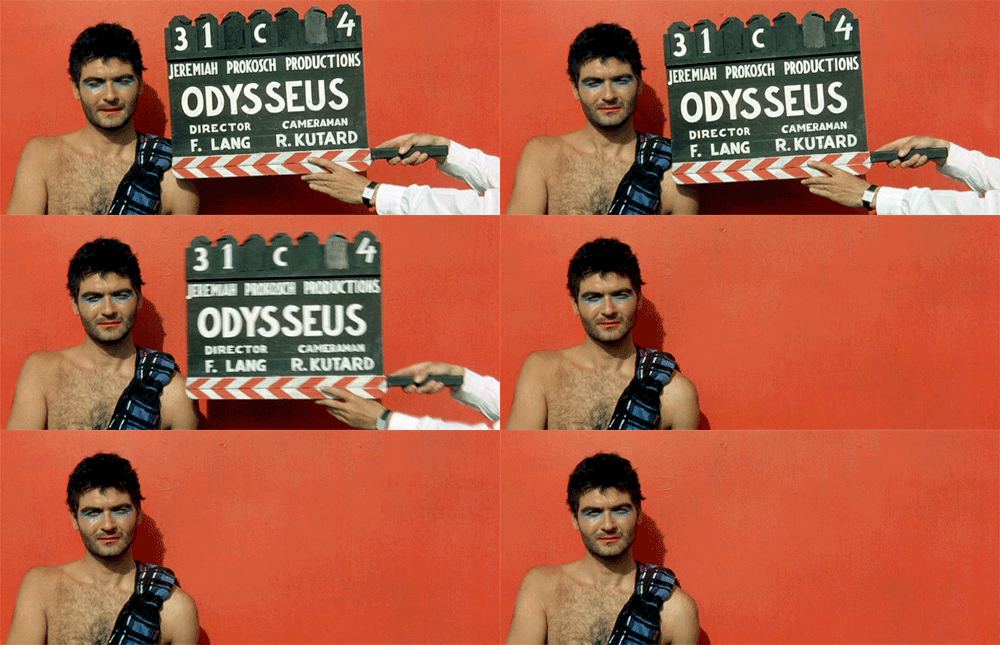
This post is inspired by the following images, which came from a previous post touching on Jean-Luc Godard's film, Contempt (Le Mépris). A creative and exemplary film of French New Wave, the film jumps to colored Classical statues, which stand out from the rest of the cinematography.


 While I wondered what the greater picture was behind the unusual coloring of ancient Greek statues in Contempt, aesthetically and symbolically speaking, I didn't give it due thought until I listened to the lecture by Dr. Larry Norman today. The talk was on the tragic passions and the interiorization of self as a mark of modernity. I began to think that perhaps the coloring of the statues is Godard's modernizing or romanticizing of the ancient Greek statues--or rather, subjects--in this film-within-a-film. In the film, there is a German director, an American producer, and a French screenwriter and cultural incongruences in between. The producer and screenwriter agree on one thing only: the theory that perhaps Odysseus left on his voyages because of his wife's infidelities.... thus obliterating the essence of marital fidelity that the Classical Penelope came to incarnate and symbolize.
It is easy to see the evacuation of meaning as we move (through the arts) from one worldview to another, Antiquity to Modernity. Everything in the strange age (Kali yuga) we are living in begins to make a bit more sense as one contemplates the times in which we live and their difference with ancient times, revealing not least of all the way that the individual's sense of the divine, the self, and the world is carved within the context of art and literature, as these communicative forms become the fossilized reflection of the individual's sense of self and place in the world. What became palpable is something we all seem to live with in modern day--the disconnection of the self from x, y, or z.
Modernity is the period beginning at the end of the Middle Ages (mid- to late 1400s) through present-day, although some French historians have said that modernity ended with the French Revolution--and that we are now in the Late Modern period. In the French Wikipedia source, this new contemporary epoch is poignantly described as as a time in which "living people, in significant numbers, can testify to historical, political, economic, and social events and a time in which the trace of these events remains relatively alive in memories and oral transmission. This period corresponds to the atomic era and the computer era, as well as to decolonization and the Cold War." Exactly.
How was the Classical carried into the modern in arts and literature? At the start of modernity, the Renaissance (1500s) looked to Antiquity, or Classicism, for artistic and literary inspiration, as evidenced by the formalization of the Greco-Latin tradition in terms of its works of art, which also developed in interesting ways in what became known in France as the French Classical period (late 1600s). We are more concerned in this post with Romanticism, a literary and artistic movement that began in Europe in the mid-1700s, where artists and writers began to free themselves of the rules of thought and form associated with classicism. This was no small break with national tradition and took several decades to take root, but in fact the movement has everything to do with the modern psyche, as Professor Norman discusses in his lecture.
As Professor Larry Norman (University of Chicago) points out, the literature and arts of Antiquity privileges exteriority, taking for its subject human action fully as it is engaged in the world, which can be observed in its exemplary images from physical nature and the human body. Inversely, Romantic literature and arts privilege interiority, taking for its subject la conscience intime du sujet (the intimate consciousness of the subject), preferring the nuances of intention and feelings to the brightness or loudness of action. However nice it is to celebrate the body, this penetrates the heart. [my translation, paraphrasing]
To support his argument, he refers to a beloved French tragedy by Jean Racine, which was inspired by the classical Phaedra of Euripides. Norman makes an excellent point: While in the Classical Greek tragedy, Phaedra is plagued by an outside force and divinity, Venus, in Racine's French version of Phèdre (1677), the torment stems more from her own psychological makeup and her awareness of the unstoppable tragic therein.
When I think of Racine's Phèdre, I think of the complexity of her psychological portrait and of her own self-condemnation, as she is hyper-aware of her psychology and how it imprisons her: she was pre-written by the infamous history of her mother, Pasiphaé, and the minotaur, as well as the scandals of her father, Minos. As Racine brilliantly indicates in his Préface, no one condemns Phèdre's criminal passion more than she: she is neither totally guilty nor totally innocent. Witness Phèdre’s declaration of love to her stepson, “J’aime / Ne pense pas qu’au moment que je t’aime, / Innocente à mes yeux je m’approuve moi-même” (v. 673-74) / "I love / Do not think in the moment that I love you that, innocent in my own eyes, I approve of myself." Racine is highly adept at handling the complexity of human emotions. Moreover, it is important to know why Racine's Phèdre loves her proudly chaste stepson: he is the purer version of her adulterous husband, Theseus.
In the first image, we see where the Phaedra of Antiquity is afflicted by incestuous love from an external source, the goddess of eros. In the second image, the modern Phèdre of Romanticism languishes in her own psychological world of demise.
To return to Professor Norman and the broader strokes of Antiquity and Modernity that he sketches, he makes a very interesting claim: that the aesthetic polarity between exteriority and interiority indicates an even deeper schism between two radically different world views, signaling an anthropological break between Antiquity and Modernity---which is to say how the man of Antiquity conceived of self and the divine and his place in the universe versus how the modern individual does. To draw out this contrast, he explains: "Classical art is an expression of paganism, seen as a materialist religion where divinity was perfectly incarnated in corporal form---while the Romantic connection expresses Christianity as a spiritualist religion, where the individual profoundly feels the imperfection of his terrestrial life, sees himself alienated from the divinity, tormented by this separation, and haunted by the sharp conscience of self that results" [my translation].
To my mind, this is to realize that we all suffer from modernity and to appreciate how the arts and literature reflect on this deep sense of lost-ness or twistedness of self within the contemporary era, let alone man's confusion, dismissal, or manipulation of the divine. As Norman says of the two world views: "This dualistic paradigm of history has the great advantage of [hoping] to explain all the formal differences that distinguish works of art throughout time." One can note in a stroll through any great museum of art that the Harmony between spirit and body, form and content, is first and foremost in Classical art, while the grotesque, the irregularity and the sublime of some modern works of art can be quite jarring.
While in ancient tragedy, as Norman says, "the tragic forces were from external sources like the oracles, the will of God, the values of the city, in the modern tragedy, the tragic interest lies in the psychology of the characters, in their hesitations rather than in their actions, in their evaluation of their own behavior or of the impotency of their inaction. So in Racine's Phèdre, one does not know if this tragedy, based on the original Greek tragedy, is truly Classical--or if it should be classified, despite Racine's homage to Euripides, as more romantic than classical. Any reader of this tragedy will ask themselves: Does the criminal passion of Phèdre for her stepson come from outside or from within? from Venus or from an interior impulse? Is the interest of [Racine's] tragedy in the passion--or more in the sharp consciousness that the character has of his/her passion (la conscience aigu que le personnage a de cette passion). Is it about mythology [divine play] or psychology?"
 Or, as with Godard's 1963 film where the Greek statues are colored and the screenwriter and producer (within the film) want to empty Penelope of her reputed faithfulness: Are the interior forces exteriorized, while the interior is simply emptied out to the point of lost-ness? Thus the post World War themes such as alienation, irony, absurdity. And in all of this, where are we now? These questions can be terrifying if taken seriously, and that is precisely what theatre, particularly tragedy, helps us to see (see Antonin Artaud's modern work on the theatre of the absurd). Is the human situation of the Late Modern period one of radical absurdity, devoid of purpose, as philosophers like Albert Camus intimated during WW2 with Le mythe de Sisyphe (1942)? As Walter Benjamin wrote regarding the trauma of the first world war and the impact on storytelling it had, "Was it not noticeable after the war that men returned from the battlefield grown silent - not richer, but poorer in communicable experience?"
 I was always struck by the alienation of self from language and its remarkable quality in Racine's 1677 spin on the ancient Greek tragedy. In many ways, Racine's Classical tragedy is a very postmodern one. To speak is to stumble upon self-awareness – or rather, to venture away from it – as Phèdre so aptly illustrates: “Insensée, où suis-je? Et qu’ai-je dit? / Où laissée-je égarer mes vœux, et mon esprit?” (v. 179-80) / "Insane, where am I? And what did I say? Where did I let my vows and my spirit wander?" Whether trailing off or making a declaration, whether intimately confiding or failing to suppress and letting something slip out, the questions of how one speaks – or does not speak – provides an emotional map by which the spectator gains intimate access to the character’s fears, obsessions, and desires. These qualities seem to mark modernity at every turn.
Does any of this give cause for painting the eyes, the mouth, and the hair of ancient Greek marble statues in blue, red, or black? I cannot say. But in the film, I can say I think it works très, très bien.
A wise man's thought: In broadening one's view of time and of the world, perhaps one can hope to not be so locked into modernity.*
*Thanks to K.M. for this Deleuze reference.


 |
| Brigitte Bardot in Contempt |
After listening to an interesting lecture on the
interiorization of self in modernity this morning, I began to realize a bit
more the relation between the coloring of ancient Greek statues in Contempt and
the content of the film, which is the story of a production of a film on
Odysseus and Penelope which, in its reinterpretation, parallels a tragic love
between the screenwriter character in the film and his wife, played by Brigitte
Bardot. As this film (1963) evokes the ancient Greek epic poem, Homer's Odyssey,
it draws on rich archetypes, smartly modernized in the trailer to the film: woman,
man, the kiss, the crazy man, the sea, tenderness, vengeance, sufferance. Then
the stairway, tragic love, betrayal, death, love, fatal beauty. All the themes
are there for une tragique histoire d'amour.
 While I wondered what the greater picture was behind the unusual coloring of ancient Greek statues in Contempt, aesthetically and symbolically speaking, I didn't give it due thought until I listened to the lecture by Dr. Larry Norman today. The talk was on the tragic passions and the interiorization of self as a mark of modernity. I began to think that perhaps the coloring of the statues is Godard's modernizing or romanticizing of the ancient Greek statues--or rather, subjects--in this film-within-a-film. In the film, there is a German director, an American producer, and a French screenwriter and cultural incongruences in between. The producer and screenwriter agree on one thing only: the theory that perhaps Odysseus left on his voyages because of his wife's infidelities.... thus obliterating the essence of marital fidelity that the Classical Penelope came to incarnate and symbolize.
 |
| Penelope (1896), Franklin Simmons |
It is easy to see the evacuation of meaning as we move (through the arts) from one worldview to another, Antiquity to Modernity. Everything in the strange age (Kali yuga) we are living in begins to make a bit more sense as one contemplates the times in which we live and their difference with ancient times, revealing not least of all the way that the individual's sense of the divine, the self, and the world is carved within the context of art and literature, as these communicative forms become the fossilized reflection of the individual's sense of self and place in the world. What became palpable is something we all seem to live with in modern day--the disconnection of the self from x, y, or z.
Modernity is the period beginning at the end of the Middle Ages (mid- to late 1400s) through present-day, although some French historians have said that modernity ended with the French Revolution--and that we are now in the Late Modern period. In the French Wikipedia source, this new contemporary epoch is poignantly described as as a time in which "living people, in significant numbers, can testify to historical, political, economic, and social events and a time in which the trace of these events remains relatively alive in memories and oral transmission. This period corresponds to the atomic era and the computer era, as well as to decolonization and the Cold War." Exactly.
How was the Classical carried into the modern in arts and literature? At the start of modernity, the Renaissance (1500s) looked to Antiquity, or Classicism, for artistic and literary inspiration, as evidenced by the formalization of the Greco-Latin tradition in terms of its works of art, which also developed in interesting ways in what became known in France as the French Classical period (late 1600s). We are more concerned in this post with Romanticism, a literary and artistic movement that began in Europe in the mid-1700s, where artists and writers began to free themselves of the rules of thought and form associated with classicism. This was no small break with national tradition and took several decades to take root, but in fact the movement has everything to do with the modern psyche, as Professor Norman discusses in his lecture.
 |
| Odysseus, Museo Archeologico Nazionale Sperlonga |
To support his argument, he refers to a beloved French tragedy by Jean Racine, which was inspired by the classical Phaedra of Euripides. Norman makes an excellent point: While in the Classical Greek tragedy, Phaedra is plagued by an outside force and divinity, Venus, in Racine's French version of Phèdre (1677), the torment stems more from her own psychological makeup and her awareness of the unstoppable tragic therein.
When I think of Racine's Phèdre, I think of the complexity of her psychological portrait and of her own self-condemnation, as she is hyper-aware of her psychology and how it imprisons her: she was pre-written by the infamous history of her mother, Pasiphaé, and the minotaur, as well as the scandals of her father, Minos. As Racine brilliantly indicates in his Préface, no one condemns Phèdre's criminal passion more than she: she is neither totally guilty nor totally innocent. Witness Phèdre’s declaration of love to her stepson, “J’aime / Ne pense pas qu’au moment que je t’aime, / Innocente à mes yeux je m’approuve moi-même” (v. 673-74) / "I love / Do not think in the moment that I love you that, innocent in my own eyes, I approve of myself." Racine is highly adept at handling the complexity of human emotions. Moreover, it is important to know why Racine's Phèdre loves her proudly chaste stepson: he is the purer version of her adulterous husband, Theseus.
In the first image, we see where the Phaedra of Antiquity is afflicted by incestuous love from an external source, the goddess of eros. In the second image, the modern Phèdre of Romanticism languishes in her own psychological world of demise.
 |
| In the Classical tragedy, Phaedra is plagued by a winged Eros (350-340 B.C.) |
 |
| Phèdre (1880), Alexandre Cabanel's romantic rendition of the 1677 version of the tragedy, where the torment comes from within |
To my mind, this is to realize that we all suffer from modernity and to appreciate how the arts and literature reflect on this deep sense of lost-ness or twistedness of self within the contemporary era, let alone man's confusion, dismissal, or manipulation of the divine. As Norman says of the two world views: "This dualistic paradigm of history has the great advantage of [hoping] to explain all the formal differences that distinguish works of art throughout time." One can note in a stroll through any great museum of art that the Harmony between spirit and body, form and content, is first and foremost in Classical art, while the grotesque, the irregularity and the sublime of some modern works of art can be quite jarring.
While in ancient tragedy, as Norman says, "the tragic forces were from external sources like the oracles, the will of God, the values of the city, in the modern tragedy, the tragic interest lies in the psychology of the characters, in their hesitations rather than in their actions, in their evaluation of their own behavior or of the impotency of their inaction. So in Racine's Phèdre, one does not know if this tragedy, based on the original Greek tragedy, is truly Classical--or if it should be classified, despite Racine's homage to Euripides, as more romantic than classical. Any reader of this tragedy will ask themselves: Does the criminal passion of Phèdre for her stepson come from outside or from within? from Venus or from an interior impulse? Is the interest of [Racine's] tragedy in the passion--or more in the sharp consciousness that the character has of his/her passion (la conscience aigu que le personnage a de cette passion). Is it about mythology [divine play] or psychology?"
 Or, as with Godard's 1963 film where the Greek statues are colored and the screenwriter and producer (within the film) want to empty Penelope of her reputed faithfulness: Are the interior forces exteriorized, while the interior is simply emptied out to the point of lost-ness? Thus the post World War themes such as alienation, irony, absurdity. And in all of this, where are we now? These questions can be terrifying if taken seriously, and that is precisely what theatre, particularly tragedy, helps us to see (see Antonin Artaud's modern work on the theatre of the absurd). Is the human situation of the Late Modern period one of radical absurdity, devoid of purpose, as philosophers like Albert Camus intimated during WW2 with Le mythe de Sisyphe (1942)? As Walter Benjamin wrote regarding the trauma of the first world war and the impact on storytelling it had, "Was it not noticeable after the war that men returned from the battlefield grown silent - not richer, but poorer in communicable experience?"
 I was always struck by the alienation of self from language and its remarkable quality in Racine's 1677 spin on the ancient Greek tragedy. In many ways, Racine's Classical tragedy is a very postmodern one. To speak is to stumble upon self-awareness – or rather, to venture away from it – as Phèdre so aptly illustrates: “Insensée, où suis-je? Et qu’ai-je dit? / Où laissée-je égarer mes vœux, et mon esprit?” (v. 179-80) / "Insane, where am I? And what did I say? Where did I let my vows and my spirit wander?" Whether trailing off or making a declaration, whether intimately confiding or failing to suppress and letting something slip out, the questions of how one speaks – or does not speak – provides an emotional map by which the spectator gains intimate access to the character’s fears, obsessions, and desires. These qualities seem to mark modernity at every turn.
Does any of this give cause for painting the eyes, the mouth, and the hair of ancient Greek marble statues in blue, red, or black? I cannot say. But in the film, I can say I think it works très, très bien.
A wise man's thought: In broadening one's view of time and of the world, perhaps one can hope to not be so locked into modernity.*
*Thanks to K.M. for this Deleuze reference.